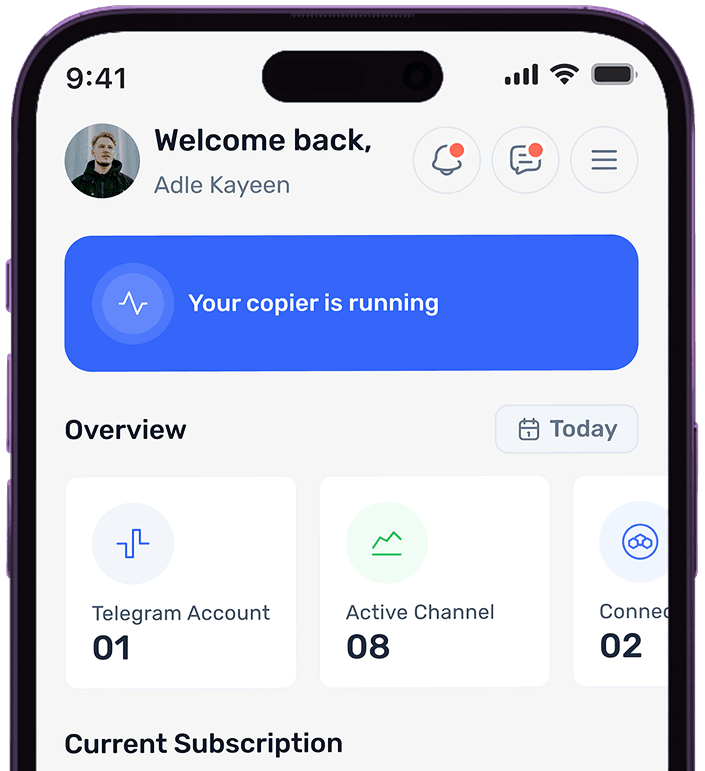
What is copy trading, explained simply?
Copy trading is automatically replicating another trader's or a signal source's trades onto your own account. When they trade, software places the same trade for you, scaled to your balance and risk settings.
- Beginner friendly
- Real-time copy trading
- Benefits & risks covered
Copy trading, in one paragraph
Copy trading is a way to automatically mirror the trades of another trader or a signal source onto your own account. When they open or close a position, or post a signal on Telegram, copy-trading software places the same trade for you, scaled to your balance and risk settings, so you don't have to trade manually.
Someone else's trades, on your account.
A source
A trader, a strategy or a Telegram signal channel you follow.
The copier does the work for you
At its simplest, copy trading means letting a trader or signal source you trust drive your account. Instead of analysing charts and placing every order yourself, software copies their trades onto your account automatically, in real time. Think of it like following a recipe from an experienced cook: you follow along and get a similar result. Crucially, your money never leaves your account, you're copying trades, not handing your funds to anyone to manage.
Your account
The matching trade is placed for you, scaled to your balance.
What happens when you copy a trade.
Copying runs quietly in the background and takes only seconds. A source trades, the software reads it, your own rules are applied, and the matching trade lands on your account.
- Source trades
- Software reads it
- Your rules apply
- Placed on your account
Copy trading vs. mirror, social & signals
These words are often used interchangeably, but they describe slightly different things. Here's the difference in plain terms.
Copy trading
Follows a person, trade for trade. A specific trader's individual trades are replicated onto your account, sized proportionally to your funds.
Mirror trading
Follows a system. You replicate a predefined strategy or algorithm rather than a person, so trades follow fixed rules instead of one trader's judgement.
Social trading
The community layer. Networks where you see, discuss and follow other traders publicly. Copying is one feature alongside discussion and leaderboards.
Signal copying
Copying alerts. You receive trade signals, often in a Telegram channel, and software executes them for you. One of the most popular forms today.
Copy trading
Follows a person, trade for trade. A specific trader's individual trades are replicated onto your account, sized proportionally to your funds.
Mirror trading
Follows a system. You replicate a predefined strategy or algorithm rather than a person, so trades follow fixed rules instead of one trader's judgement.
Social trading
The community layer. Networks where you see, discuss and follow other traders publicly. Copying is one feature alongside discussion and leaderboards.
Signal copying
Copying alerts. You receive trade signals, often in a Telegram channel, and software executes them for you. One of the most popular forms today.
The main ways people copy trades
There are a few common approaches, each suited to different needs and levels of experience.
Broker copy platforms
Platforms such as eToro or ZuluTrade let you browse traders and copy them inside the broker's own app, with performance stats built in.
Telegram signal copiers
Tools that read signals from Telegram channels and groups and copy them to MetaTrader or other platforms, ideal if you already follow signal providers.
Social trading networks
Communities where traders share ideas and results publicly, and copying is one feature among discussion and leaderboards.
Managed accounts (MAM/PAMM)
A manager trades a pooled account for you. This is closer to managed investing than self-directed copying, and works differently.
Broker copy platforms
Platforms such as eToro or ZuluTrade let you browse traders and copy them inside the broker's own app, with performance stats built in.
Telegram signal copiers
Tools that read signals from Telegram channels and groups and copy them to MetaTrader or other platforms, ideal if you already follow signal providers.
Social trading networks
Communities where traders share ideas and results publicly, and copying is one feature among discussion and leaderboards.
Managed accounts (MAM/PAMM)
A manager trades a pooled account for you. This is closer to managed investing than self-directed copying, and works differently.
The benefits of copy trading
Copy trading has grown quickly because it removes some of the biggest barriers to getting started in the markets.
Beginner accessible
You don't need years of chart experience to take part, the software handles execution for you.
Time saved
You're not glued to a screen. Trades are copied automatically, even when you're asleep or busy.
Fast, consistent execution
Software places trades in seconds and doesn't hesitate, so you're less likely to miss entries.
Less emotional trading
The copier follows the source's trades and your rules rather than reacting to fear or greed.
Diversification
Copy several traders or channels at once, spreading your activity across styles and markets.
You keep control
Your funds stay in your account and your risk rules apply to every copied trade.
Beginner accessible
You don't need years of chart experience to take part, the software handles execution for you.
Time saved
You're not glued to a screen. Trades are copied automatically, even when you're asleep or busy.
Fast, consistent execution
Software places trades in seconds and doesn't hesitate, so you're less likely to miss entries.
Less emotional trading
The copier follows the source's trades and your rules rather than reacting to fear or greed.
Diversification
Copy several traders or channels at once, spreading your activity across styles and markets.
You keep control
Your funds stay in your account and your risk rules apply to every copied trade.
Who copy trading suits
Copy trading fits some goals far better than others. Here's a quick, honest read on where it tends to work, and where it doesn't.
You want execution handled
People short on time or experience who want market exposure without trading full-time, and active traders who already follow signal providers and simply want to automate execution rather than place every order by hand.
You expect guaranteed profit
Anyone expecting effortless, guaranteed profit, that isn't what copy trading offers. If you're not willing to set risk limits, verify your sources and check in on results, a hands-off approach can quietly work against you.
How to start copy trading
If you decide to try it, a sensible, low-risk path looks like this.
Choose a source
Pick a trader, strategy or Telegram signal channel with a verifiable track record rather than bold, unproven claims.
Pick your tool
Select a copy-trading platform or signal copier that connects to your broker and platform: MT4, MT5, cTrader, DXtrade or TradeLocker.
Set your risk rules
Decide your lot size, risk per trade and stop-loss preferences before you copy anything, so you stay in control.
Test on demo, then go live small
Confirm everything behaves as expected on a demo account, then switch to live with small sizes and scale slowly.
Monitor and adjust
Copy trading isn't set and forget, review your results and refine your settings and sources over time.
Copy trading, made simple with trade2sync
Copy trading, answered
The questions beginners ask most before they start copying trades.
Ready to see it work?
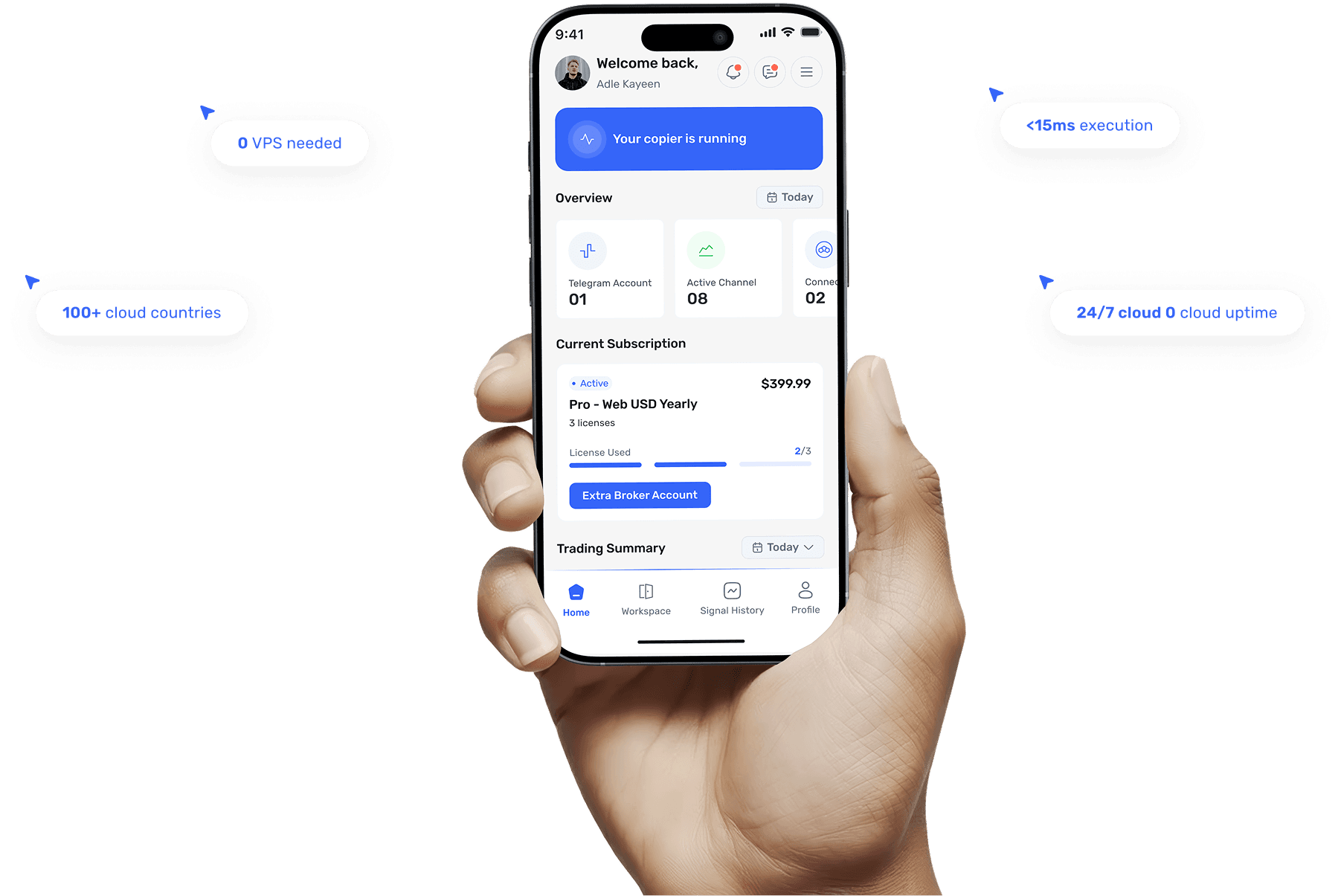
Explore how trade2sync copies Telegram signals to your own account, on your own risk rules.
See copy trading in action.
trade2sync copies signals from your Telegram channels to MT4, MT5, cTrader, DXtrade and TradeLocker automatically, on your own risk rules. Explore how it works before you commit.
Download Now